The owner’s project manager asks for two more coordination workshops and an earlier 90% design submission.
The request sounds manageable. The project manager knows the team can probably fit it in, so the workshops are scheduled and the submission date is moved. Only later does the commercial question arrive: were the workshops additional services, and who had authority to approve the change?
That question cannot be answered from the project plan alone. It cannot be answered from the request email alone either. The answer begins with the current signed scope: the services, quantities, assumptions, exclusions, schedule, compensation and change procedure that apply as of today, with the source for each term.
For an architecture or engineering firm, an additional service is not simply work that feels new. It is a conclusion reached after the current contractual baseline has been established.
Why the baseline matters now
The 2026 A&E market is profitable, but less forgiving of small execution leaks. The 47th Deltek Clarity A&E Industry Study reports operating profit on net revenue of 16.7%. It also says 75% of projects were on or under budget while 40% were behind schedule, and describes project managers as balancing increasingly complex responsibilities.
Those figures do not show an industry in distress. They show why incremental decisions matter. A workshop added without checking the signed quantity, an accelerated milestone accepted without reviewing the change procedure, or a role expanded through meeting minutes can consume margin and alter risk even when the project remains within its total fee.
The American Society of Civil Engineers’ 2026 claim-reduction guidance makes the operational point directly: changes in scope, schedule or fee should be handled through the procedure in the governing agreement, and a project team should not assume that meeting minutes satisfy agreement-specific approval requirements.
Before the firm can follow that procedure, someone has to know what the agreement currently says.
“Additional” is a comparison, not a label
A client request has no commercial meaning in isolation. It becomes included, excluded, additional or unresolved only when compared with the current signed position.
Consider a request for another design workshop. The answer may depend on several different terms:
- the task order may include three workshops;
- a later amendment may add one more;
- the fee exhibit may set hourly rates for additional meetings;
- the professional-services agreement may require written authorization before additional services begin;
- a delegation schedule may identify who can sign that authorization;
- a later amendment may have changed the milestone affected by the workshop.
Opening the original task order gives part of the answer. Opening the newest amendment gives another part. Neither is the current scope by itself.
This is the same agreement-family problem described in How to identify the current terms of an agreement, applied to a live project decision.
The agreement family is the baseline
For an A&E engagement, the commercial position may be distributed across:
- the professional-services or owner–architect agreement, which sets the general duties, change mechanics, payment terms and authorized process;
- a task order, service order or scope exhibit, which defines the project, phases, deliverables and assumptions;
- a fee exhibit or rate schedule, which prices basic and additional services;
- an amendment or supplemental agreement, which changes selected services, dates, fees or responsibilities;
- an additional-services notice, which records a proposed change and its effect;
- a written authorization, where the agreement requires one before work begins.
AIA Contract Documents describes G801–2017 as a notice used under owner–architect agreements when additional services are identified. The form’s existence is a useful reminder: the request, the notice and the authorization are different records with different functions.
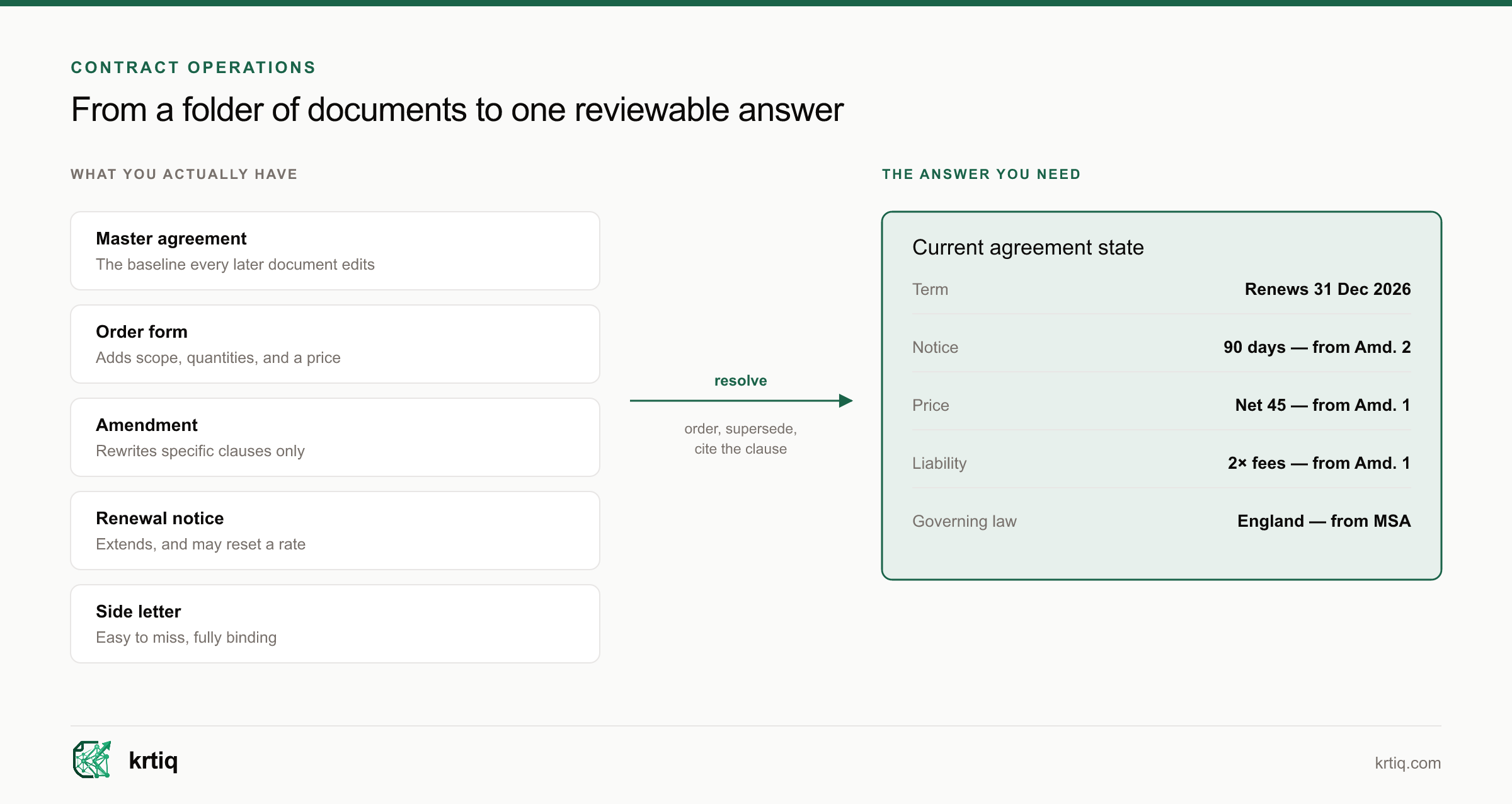
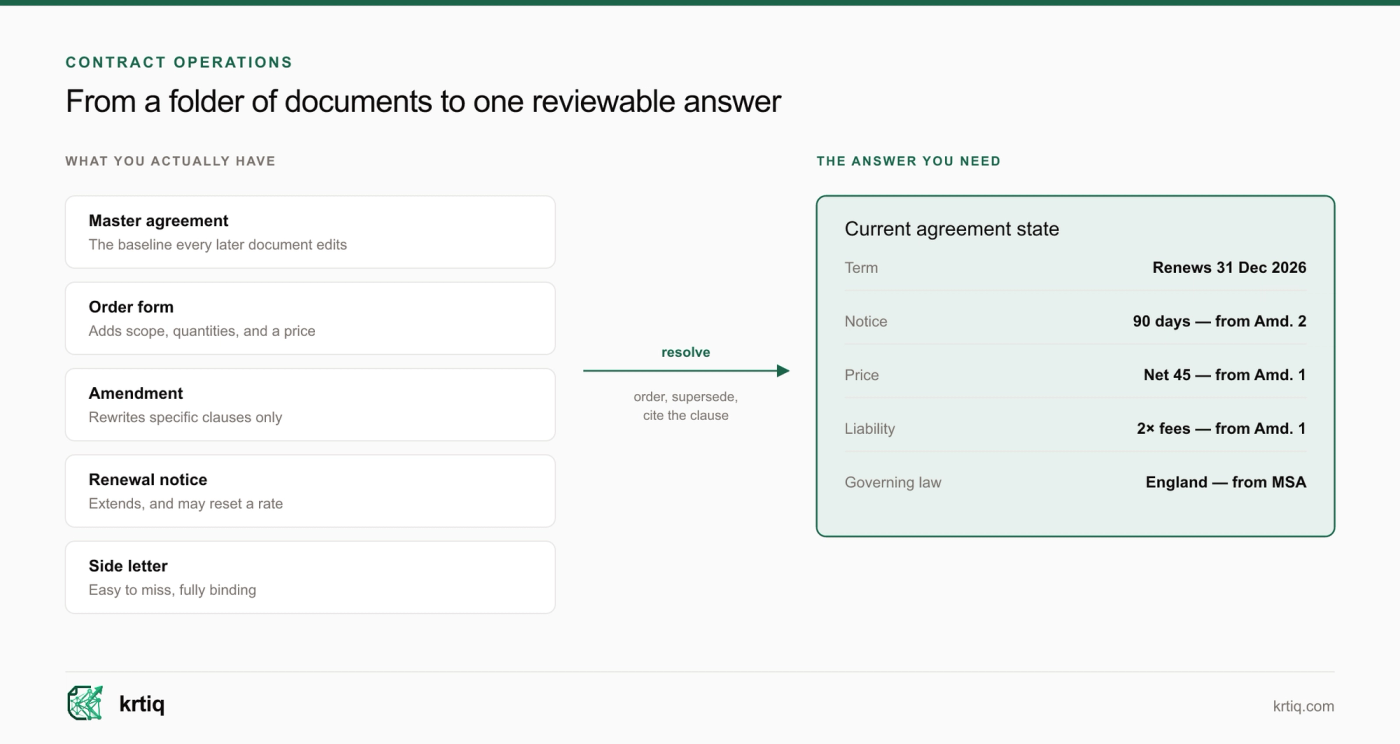
The baseline is produced by resolving the family term by term. A later amendment may add a study without changing the original number of workshops. It may move the design-development milestone without changing the rate schedule. It may expand one responsibility while leaving the approval path untouched.
The newest document is not automatically the complete answer. It changes what it addresses and leaves the rest of the agreement family in place.
Seven fields to resolve before work starts
A general contract summary is too broad for an additional-services decision. The project manager needs a compact current-scope record containing seven fields.
1. Services and deliverables
What phases, reports, drawings, models, meetings and construction-phase
services are included?
2. Quantitative limits
How many workshops, site visits, review cycles, alternatives or submissions
were bought? A named service without a quantity can still require judgement;
the record should not invent one.
3. Assumptions and owner dependencies
What information, surveys, decisions, access or third-party work was the owner
expected to provide? A failed assumption can change the work even when no one
has requested a new deliverable.
4. Exclusions and retained responsibilities
Which services were expressly excluded, and which party retained responsibility
for them?
5. Current schedule
Which milestones apply now, after every signed extension or acceleration? The
date in the original task order may no longer govern.
6. Compensation mechanics
What fee, rate schedule or pricing method applies if the work is authorized?
This does not decide what to charge; it identifies the signed commercial
mechanism available for review.
7. Change procedure and authorized approver
What notice is required, in what form, and whose approval is needed? The person
requesting the work may not be the person authorized to amend the agreement.
The AIA’s guidance on a comprehensive owner–architect agreement similarly identifies scope and deliverables, fees, and schedule as core elements, and specifically asks firms to clarify the process for additional services and whether advance written approval is required. See The value of a comprehensive owner-architect contract.
A worked current-scope example
Consider a fictional multidisciplinary engineering firm working on a municipal facility upgrade.
The professional-services agreement establishes the change procedure. Task Order 4 includes three stakeholder workshops, a 60%, 90% and issued-for- construction submission, and an owner-provided site survey. Fee Exhibit B sets hourly rates for additional services. Amendment 1 adds hydraulic modelling and moves the 90% submission from 17 October to 14 November.
All three workshops have been held. The owner’s project manager then emails a request for two more workshops and asks the firm to bring the 90% submission forward to 31 October.
A useful current-scope view would look like this:
| Term | Current signed position | Governing source | Relevance to request |
|---|---|---|---|
| Stakeholder workshops | Three | Task Order 4 §2.4 | All three have been used; two more are not in the recorded quantity |
| Hydraulic modelling | Included | Amendment 1 §1 | Already added; not part of the new decision |
| 90% submission | 14 November | Amendment 1 §2 | The requested 31 October date would alter the current milestone |
| Additional-services rates | Discipline rates in Fee Exhibit B | Fee Exhibit B | Provides the signed pricing reference if additional work is authorized |
| Change mechanism | Written amendment | Professional Services Agreement §8 | Identifies the required instrument |
| Authorized approval | Owner procurement officer and firm principal | Professional Services Agreement §8.3 | The requesting project manager is not the recorded approver |
This record does not make the commercial or legal decision. The firm may decide to quote the workshops, exchange them for another activity, absorb them deliberately, negotiate an accelerated schedule, or seek professional review where the wording is unclear.
What the record changes is the starting point. The conversation begins with the current signed quantity, milestone, rate reference and approval route—not with memory or the urgency of the latest email.
Keep the request separate from the authorization
Project records answer different questions and should not be collapsed into one status.
- A request shows what someone asked the firm to do.
- A notice records that the firm believes the request may affect scope, schedule, fee or risk.
- An authorization records the approval required by the governing agreement.
- An amendment changes the signed position when that is the required instrument.
An email or meeting minute can be important evidence of a request. Its effect on the agreement depends on the contract language, the authority of the people involved and the applicable professional or legal review. It should not be promoted silently from “requested” to “governing.”
That distinction also makes handovers safer. A new project manager can see that a workshop was requested, a notice was sent and approval remains outstanding, instead of inheriting a folder in which every document looks equally final.
A five-step operating check
When a possible change appears, run this bounded review before the delivery team treats it as accepted.
- Record the request as received. Preserve who asked, what changed and when, without assuming its contractual effect.
- Fix the as-of date. The question is what governs now, not what governed when the project began.
- Assemble the agreement family. Include the base agreement, task order, scope and fee exhibits, every amendment, and relevant notices or signed authorizations.
- Resolve the affected fields only. Services, quantities, assumptions, schedule, pricing and approval mechanics usually matter more than a general summary of the whole contract.
- Route the decision with evidence. Put the current term and its source in front of the project, commercial or legal owner who is responsible for the next action.
The result should be inspectable by someone who was not in the original negotiation.
Where krtiq fits—and where it does not
Agreement Intelligence can ingest professional- services agreements, work orders, scope and pricing exhibits, amendments, addenda and change orders, reconcile related documents into agreement families, and maintain supported current terms with the source document available for inspection.
The Verification Workspace keeps human confirmation, corrections and decision history attached to that portfolio. That matters when a referenced exhibit is missing, a parent document is ambiguous or the language genuinely requires judgement.
krtiq does not monitor RFIs, meeting minutes, project tasks, timesheets or design activity to detect live scope creep. It does not automate billing, manage construction deadlines, decide whether a service is legally compensable, or replace professional review.
Its role is narrower: maintain the signed commercial baseline and show the evidence behind it, so the human decision happens before unexamined work becomes the project’s new normal.
Where to start
Choose one active project that has at least one amendment or supplemental service request. Collect:
- the professional-services or owner–architect agreement;
- the active task or service order;
- the scope, assumptions and fee exhibits;
- every signed amendment or supplemental agreement;
- any additional-services notices and written authorizations.
Set today as the as-of date and answer one question:
What services, quantities, milestones and change approvals apply today, and which signed source supports each answer?
If the answer comes from four documents, the project is not unusually messy. That is how the commercial position was constructed. The task is to make it visible before the next request becomes work in progress.
If you want to see how krtiq maintains that source-backed baseline across an active project portfolio, request a demo.
The short version
Additional services do not begin with a timesheet code or a change-order form. They begin with a comparison between a new request and the current signed scope.
For an A&E firm, that scope may be spread across the professional-services agreement, task order, fee exhibit, amendments and authorization records. The usable answer is not “two extra workshops.” It is “three workshops are included under Task Order 4 §2.4; all three have been used; the proposed two more require review under the written-change procedure in §8.”
That is a commercial position a project manager can inspect, a finance team can price and an authorized decision-maker can act on.
krtiq is an information-management product, not legal advice or a substitute for professional review.