"What are we actually on with this customer?" is a question that sounds simple and takes a week. Not because the answer is hard to reason about, but because nobody can agree on what has to be true before an answer counts.
This is a method for producing one. It is deliberately mechanical: the point is that a different person, running the same steps on the same documents, lands on the same answer.
What "current" has to mean
Before assembling anything, fix the definition. A current agreement state is the set of terms in force as of a specific date, with each term traced to the clause that set it.
Two details in that sentence do real work.
As of a specific date. Usually today, but not always. Renewal decisions ask about the state at the notice deadline. Disputes ask about the state on the day something happened. If your answer has no as-of date attached, it silently means "today", and it will be quoted back to you six months from now as though it still does.
Traced to the clause. A term without a source is not reviewable. It is a conclusion someone reached from unknown inputs, and the only way to check it is to redo the whole exercise.
Step 1 — Inventory the family, not the folder
Start from the base agreement and pull everything that references it, plus everything it references. Expect to find documents in at least four places: a contract repository, a sales or billing system, shared drives, and email.
Document types that belong in the family and are routinely left out:
- Order forms and statements of work, which add scope and price, and often incorporate the master agreement by reference
- Amendments and addenda, including ones that only extend a date
- Renewal and non-renewal notices, which are unilateral but binding
- Side letters, short and rarely filed with the contract
- Assignment and novation agreements, which change who the counterparty is
- Termination notices for part of the scope, which narrow rather than end
A missing document and a document that does not exist look identical from the inside. That asymmetry is why inventory comes first and why it is worth being systematic rather than opportunistic about it.
Step 2 — Establish the links
Each document needs to be attached to the agreement it modifies. References are often imprecise — a title that does not quite match, a date that is off by a few days, or an amendment that names no parent at all and relies on context.
Where a link is ambiguous, record it as ambiguous rather than guessing. A term attached to the wrong contract is worse than a term you know you cannot place, because it looks settled.
Step 3 — Put them in effect order
Sort by effective date, not execution date and not amendment number. All three commonly disagree. Amendment No. 3 can be effective before Amendment No. 2 if the negotiations overlapped, and an amendment signed in December with a January effective date does not change anything in December.
Where a document has no stated effective date, the execution date is usually the working assumption — but note it as an assumption, because it is one.
Step 4 — Resolve clause by clause
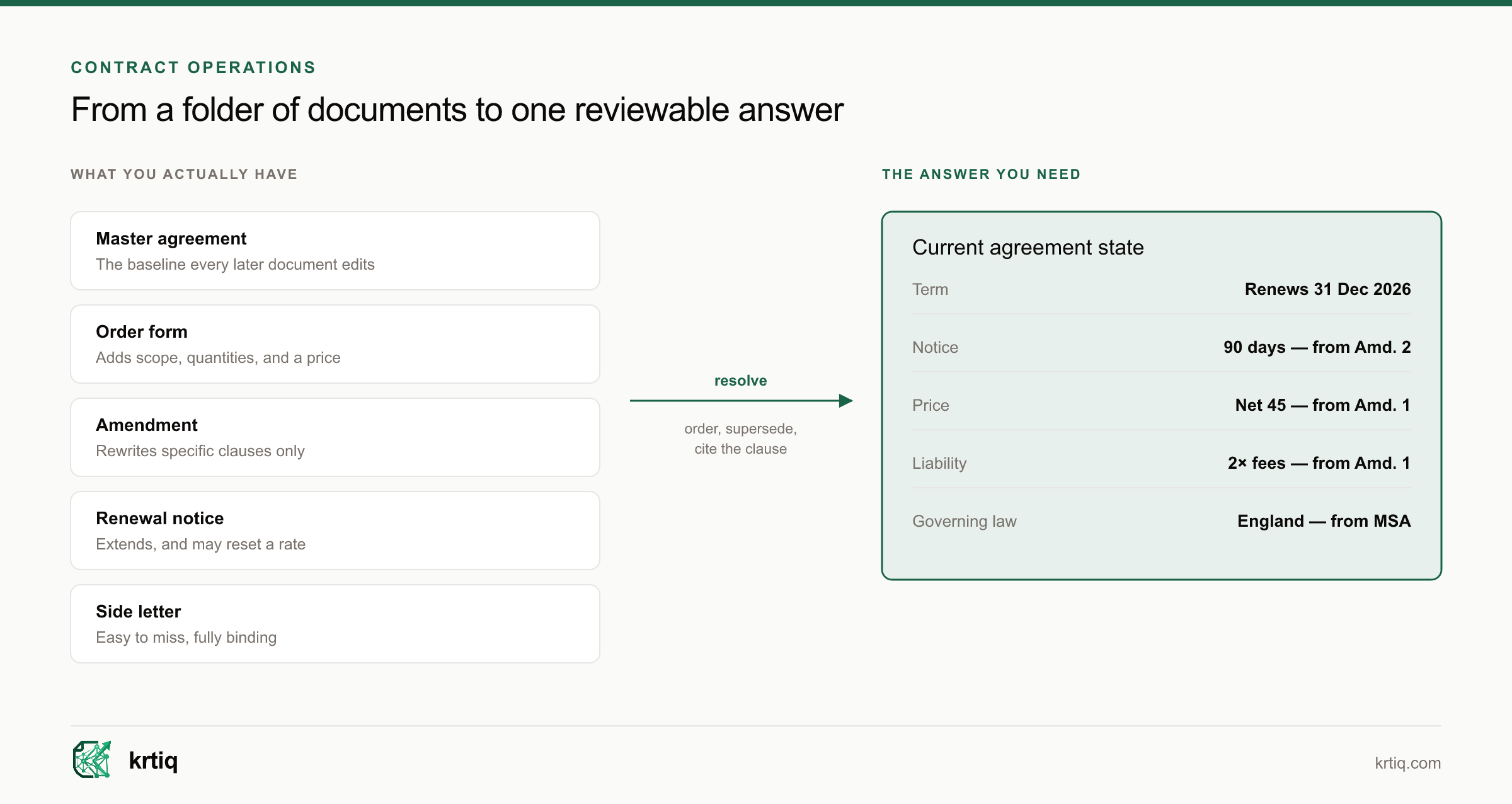
For each term you care about, walk the ordered list and take the last document that addressed that term specifically. This is the step where the method earns its keep, and the rule that makes it work is narrow: an amendment changes what it names and leaves everything else alone.
That logic, and the ways it gets misapplied, is covered in detail in MSA vs. amendment: which terms govern today?.
Two cases need care. An amended and restated agreement replaces the original in full rather than editing it, so the chain restarts there. And a term changed for a defined window may revert afterwards, or may not say — which is a question to flag, not to resolve by assumption.
Step 5 — Record the evidence, and the gaps
The finished state should read like this:
| Term | Value | Source | Effective |
|---|---|---|---|
| Notice period | 90 days | Amendment No. 2, cl. 3.1 | 2 Jul 2026 |
| Payment terms | Net 45 | Amendment No. 1, cl. 2 | 8 Nov 2023 |
| Liability cap | 2× fees paid | Amendment No. 1, cl. 5 | 8 Nov 2023 |
| Governing law | England & Wales | MSA, cl. 22 | 12 Mar 2023 |
And it should record what it could not establish just as explicitly: a referenced exhibit nobody can find, an amendment whose parent is ambiguous, a term whose reversion date is unstated. Those are the entries that cost money later, and they disappear the moment a summary is written as though everything were known.
Why the method matters more than the answer
Any competent person can work out one customer's current terms given a day and the documents. The difficulty is that the answer decays. A renewal notice arrives, an order form is signed, and the state produced last quarter is now subtly wrong, with nothing to indicate which parts changed.
That is the case for treating the current state as something maintained rather than something researched — and for keeping every term attached to its source, so a new document updates a specific line rather than invalidating the whole picture. It is what Agreement Intelligence is built to do, and what the Verification Workspace exists to keep honest when a machine conclusion needs a human to confirm it.
The related question — which obligations this state actually creates for you, and where they entered — is covered in The obligations hidden across your contract portfolio.
A short checklist
- Fix the as-of date.
- Inventory the family, including the document types nobody files.
- Link each document to its parent; mark ambiguous links as ambiguous.
- Order by effective date.
- Resolve each term to the last document that named it.
- Record the source clause for every term, and record the gaps as gaps.
If a step is skipped, the answer is still probably right. "Probably right" is fine until the first time it is not, which is usually the renewal you had already assumed was automatic.