Someone asks what the notice period is on your largest customer. You open the master services agreement, find clause 14.2, and read "sixty (60) days". You answer sixty days. You are wrong, and you will not find out for four months.
The MSA was signed three years ago. Amendment No. 2, executed last July, changed the notice period to ninety days as part of a renewal negotiation nobody outside the deal team followed closely. Clause 14.2 still says sixty. It will say sixty forever. The amendment did not go back and edit the original document, because that is not how amendments work.
An amendment changes only what it names
The instinct is to treat the newest document as the answer. It usually is not. A typical amendment does exactly two things: it identifies specific provisions of an existing agreement, and it states what those provisions now say. Everything it does not mention continues to run on the original terms.
That means the agreement in force is rarely any single document. It is the base agreement, as modified by each later document, in order, for the specific clauses each one touched.
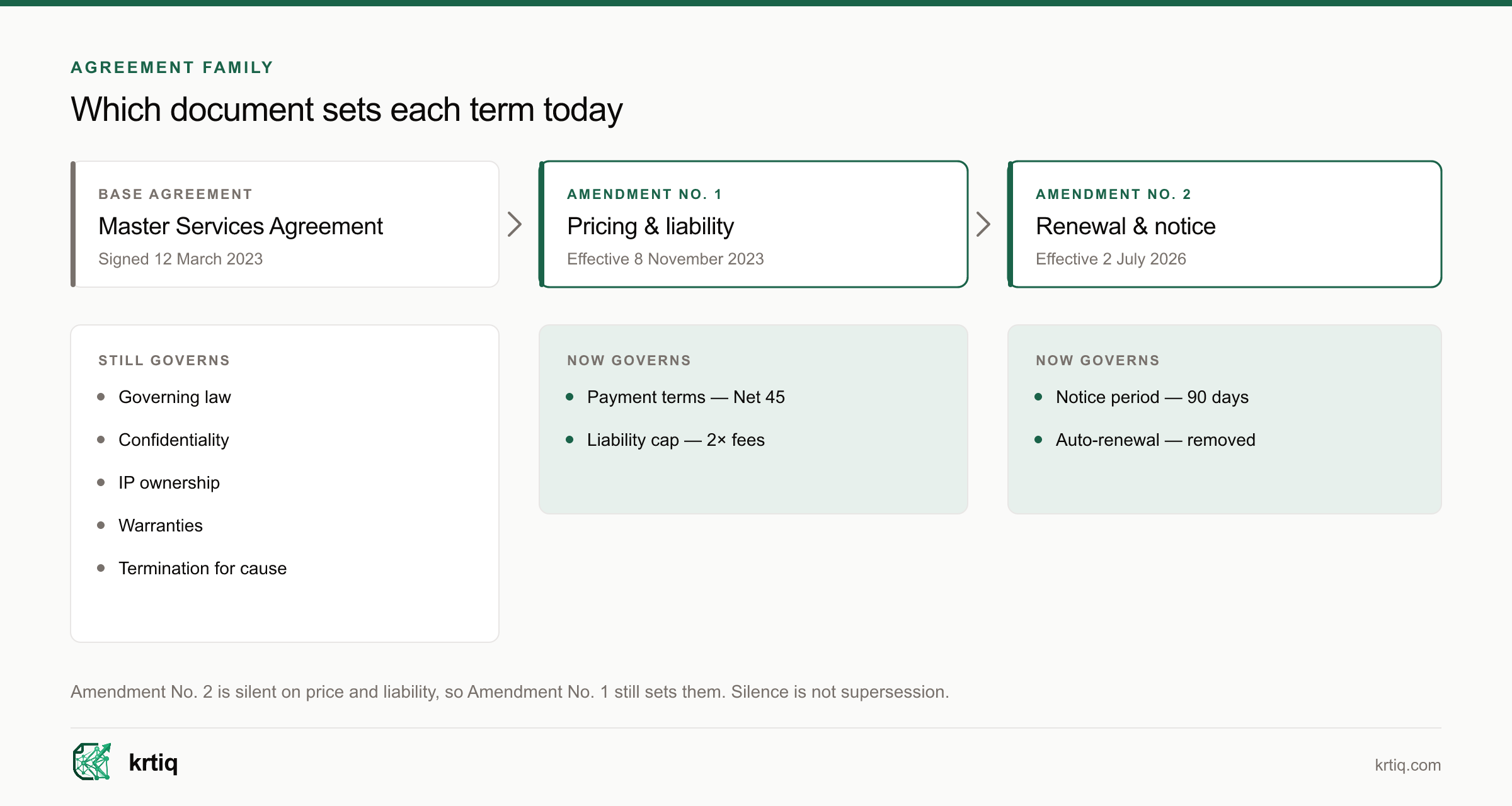
The diagram above shows the shape of the problem. Amendment No. 1 reset payment terms and the liability cap. Amendment No. 2 reset the notice period and removed auto-renewal. Neither touched governing law, confidentiality, or IP ownership, so the MSA still sets those — three years on, through two rounds of renegotiation.
Note what Amendment No. 2 did not do. It is silent on price and liability, so Amendment No. 1 still governs them. A later document does not reset an earlier one just by existing. Silence is not supersession.
The four questions that decide the answer
For any term you need to be confident about, work through these in order.
1. Which documents belong to this agreement? Not which documents are in the folder. Agreement families scatter: the MSA in a contract system, the order form in a sales tool, the amendment as a PDF on someone's laptop, the side letter in an email thread. A document you have not found cannot be reasoned about, and its absence looks exactly like it not existing.
2. What does each one actually reference? Amendments identify their parent by title and date, and the reference is often imprecise — "the Master Services Agreement dated on or about March 2023" when the execution date was the 12th. Order forms may incorporate the MSA by reference without naming it at all. These links are what turn a pile of files into a family, and getting one wrong silently attaches a term to the wrong contract.
3. In what order do they take effect? Execution date and effective date are frequently different, and it is the effective date that governs. Amendments are not always executed in the order they are numbered. Where two documents touch the same clause, the order decides which one wins.
4. Which clause does each one change? This is the granular part, and the part most often skipped. "Amendment No. 1 amends the agreement" is not a usable answer. "Amendment No. 1 replaces clause 9.1 in its entirety and inserts a new clause 9.4" is.
Where the answer usually goes wrong
A few failure patterns account for most incorrect answers:
- Reading the base agreement only. The most common error, and the most confident one, because clause 14.2 really does say sixty days.
- Reading the newest document only. The opposite error. The newest amendment is silent on almost everything.
- Treating a restatement as an amendment. An amended and restated agreement does replace the original wholesale. Mixing the two up inverts the answer.
- Missing a side letter. Side letters are short, unnumbered, rarely filed with the contract, and fully binding.
- Assuming an expired amendment is dead. Some amendments change a term for a defined window and revert afterwards; others do not say what happens next.
- Trusting a summary field. A "notice period" column in a spreadsheet is someone's conclusion from an unknown date, with no way to check what it was based on.
Build the family, then answer the question
The reliable method is to assemble the agreement family first and answer questions from it second — not to go hunting per question. Concretely:
Collect every document that references the base agreement, or that the base agreement references. Record each one's effective date, not just its execution date. For each document, list the specific clauses it changes. Then, for any term, walk the chain in effective-date order and take the last document that addressed that term.
The output should be a term with a date and a source: not "90 days" but "90 days, set by Amendment No. 2 clause 3.1, effective 2 July 2026." The first is a claim. The second is a claim someone else can check in thirty seconds.
Why this is worth systematising
Doing this once for one customer is an afternoon. Doing it across a portfolio, and keeping it current as new documents arrive, is the part that does not scale by hand — which is where most contract questions quietly revert to reading the MSA and hoping.
This is the problem Agreement Intelligence is built for: constructing the family, resolving which document governs each term, and keeping every answer attached to the clause that produced it. When the answer changes because a new amendment lands, the change is visible rather than discovered late.
The related question — assembling that current state from a pile of signed documents in the first place — is covered in How to identify the current terms of an agreement.
The short version
An amendment changes what it names and nothing else. The agreement in force is the base document as modified by each later one, clause by clause, in effective-date order. And any answer worth relying on carries its source, so the next person does not have to redo the work to trust it.
If your answer to "what is the notice period?" cannot be traced to a specific clause in a specific document with a specific date, it is not an answer yet. It is a guess that happens to be written down.