An agency client asks for one more landing page.
The request sounds close to the campaign already in delivery, so the account manager approves it, the designer opens a ticket, and the commercial question arrives after the work has begun: was this page already included?
The project board cannot answer that question reliably. It records what the team plans to do. The agreement records what the client bought. Those two things may begin together and then drift as deadlines move, markets are added, rates change, and informal decisions accumulate around the signed documents.
Before calling the request scope creep, the agency has to establish the current signed scope: the deliverables, quantities, revisions, assumptions, exclusions, dependencies and prices that apply as of a particular date, with the source for each answer.
That is not a search for one contract. It is a reconstruction of the commercial boundary.
Scope is a current-state question
Most agency teams know where the statement of work is. The harder question is whether that statement of work still gives the complete answer.
The SOW may say four landing pages and two revision rounds. A pricing exhibit may set the rate for additional work. A later change order may add a Canadian market and move the delivery date without changing the number of pages. A renewal letter may extend the engagement and reset the monthly fee. The MSA may still control how changes must be approved.
Each document can remain relevant at the same time.
This is why “What is in scope?” needs an as-of date. The answer on 1 May may be different from the answer on 1 September, even though most of the original SOW still governs.
Agency economics make that distinction material. Promethean Research’s 2026 Digital Agency Industry Report puts average agency net margin at 13% in 2025 and finds that most agencies use a mixture of time-and-materials, fixed-bid and retainer pricing. Only 8% or fewer rely exclusively on any one model. A retainer therefore describes a billing relationship; it does not, by itself, define every unit of work the client can request.
The boundary is also under more pressure. The 4As 2026 New Business Activity & Resources Survey reports that project-based opportunities slightly outweigh agency-of-record engagements among its respondents, 84% of whom were independent agencies. Smaller, more flexible engagements create more boundaries to define and more changes to reconcile.
The agreement family is the unit of analysis
For a typical agency account, the signed position can be distributed across:
- the MSA, which sets the operating rules, payment mechanics, intellectual property position, liability and change process;
- the SOW or retainer schedule, which defines services, quantities, fees, milestones, dependencies and exclusions;
- a pricing exhibit or rate card, which prices additional work;
- a change order or amendment, which changes selected deliverables, fees or dates;
- a renewal document, which may extend the term or reset a price;
- an approval or side letter, which may alter one specific commitment.
No single file necessarily contains the current answer. The useful unit is the agreement family: the base agreement and every document that later added to, extended or changed it.
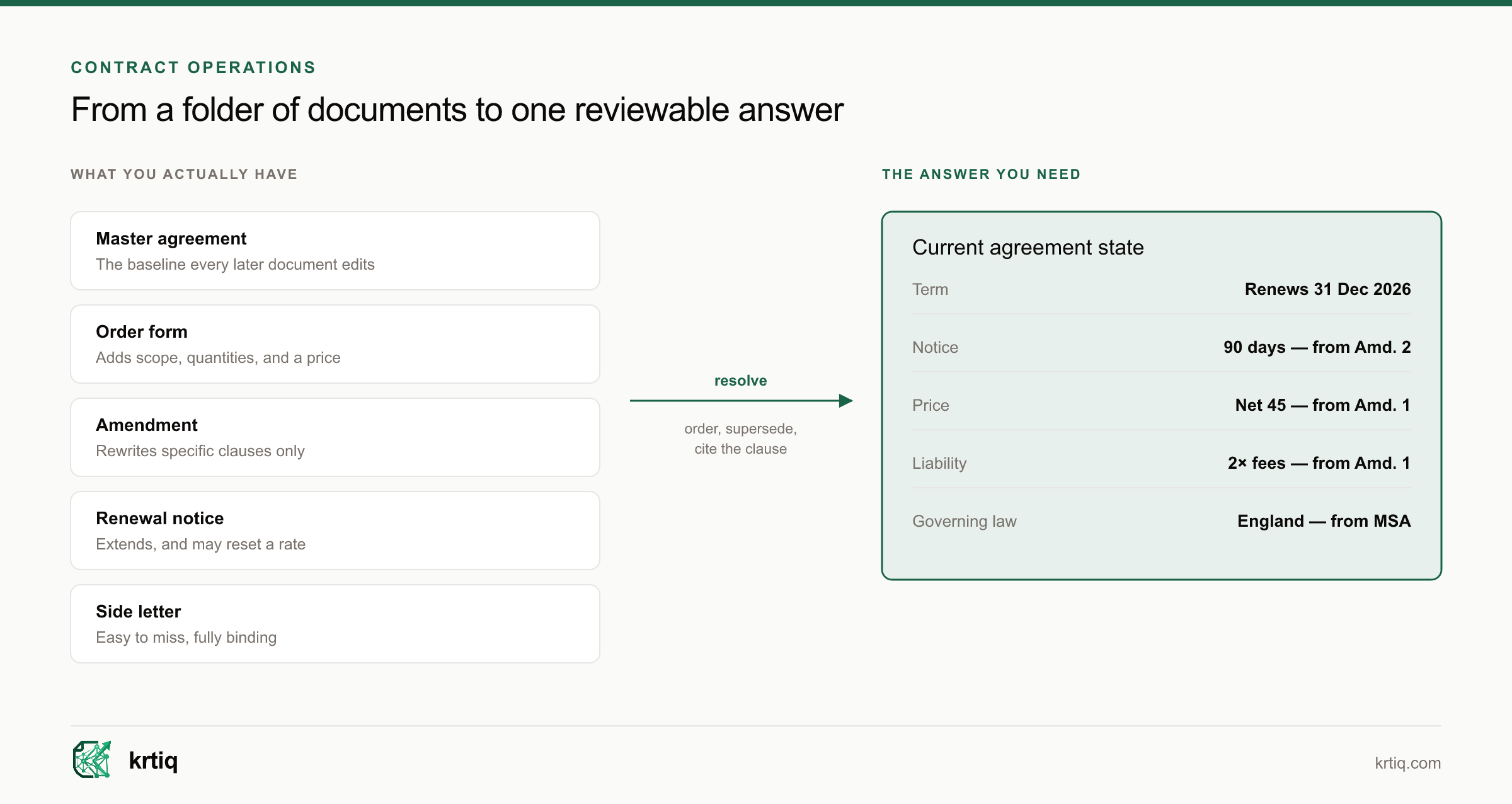
The job is not to choose the newest document and ignore the rest. It is to resolve each commercial term separately. A later document can replace the delivery date while leaving the page count, revision limit and additional-work rate untouched.
That term-by-term resolution is the difference between a current answer and a recent document.
Four ways the boundary becomes unreliable
The team opens the SOW and stops.
This works until the first signed change. After that, the SOW is still relevant
but no longer sufficient. It may contain the current deliverable quantity and
an obsolete date in adjacent clauses.
The project plan becomes the commercial record.
A project board is designed to coordinate delivery. Tasks can be added,
renamed, split or moved for operational reasons without changing the signed
scope. Treating the board as the contract quietly converts delivery decisions
into commercial commitments.
The latest change order is treated as a replacement agreement.
Most changes are narrow. If a change order adds a market and moves a deadline,
it does not automatically erase the original revision limit, exclusions or
rate card. Reading it alone can understate or overstate what remains in force.
The answer survives as account-team memory.
Memory is fast and often directionally right. It is also difficult to inspect,
handover or defend. “I think we agreed to include that” is not the same as a
signed source, particularly after the person who negotiated the account has
moved on.
The result is not always dramatic scope creep. More often it is a series of small, unpriced decisions made without a dependable boundary.
Ignition’s 2025 survey of 273 US agency managers and executives gives the scale of that operational leakage: 57% reported losing $1,000–$5,000 each month to unbilled project work, 30% reported more than $5,000, and 78% said they rarely or only sometimes charged for out-of-scope work.
Those findings do not prove that contract intelligence recovers the loss. They show why the scope conversation should begin before work starts and from evidence rather than recollection.
A worked current-scope example
Consider a fictional engagement between an agency and a client.
The MSA establishes the approval process for changes. The original SOW includes four campaign landing pages, two revision rounds per page and delivery by 15 September. A pricing exhibit sets additional creative work at £160 per hour. A later change order adds Canada as a target market and moves delivery to 30 September.
The client then asks for a fifth landing page.
A useful current-scope view would look like this:
| Commercial term | Current signed position | Governing source |
|---|---|---|
| Landing pages | Four | SOW §2.1 |
| Revision rounds | Two per page | SOW §2.4 |
| Target markets | UK and Canada | Change Order 1 §1 |
| Delivery date | 30 September | Change Order 1 §2 |
| Additional-work rate | £160/hour | Pricing Exhibit A |
| Change approval | Written approval by named representatives | MSA §6 |
The change order altered the market and the date. It did not alter the page count. On the signed evidence available, the fifth page is not already included in the original quantity.
That conclusion does not tell the agency what commercial decision to make. The account lead may quote additional work, exchange it for another deliverable, accept it deliberately as goodwill, or seek professional review if the wording is unclear.
The value of the current-scope view is narrower and more practical: everyone makes that decision from the same supported position.
What a usable scope view contains
A general contract summary is not enough. For an operating team, the view needs five properties.
An as-of date.
Without a date, a correct answer can be reused after it becomes stale.
A separate answer for each term.
Deliverables, quantities, revisions, dates, dependencies, exclusions and
prices may each be governed by a different document.
The source clause beside the answer.
If a client or colleague challenges the position, the route back to the signed
language should be immediate.
Visible change history.
When an amendment replaces a date or price, the earlier value should become
history rather than disappear. The mechanics are explained further in
MSA vs. amendment: which terms govern today?.
Explicit gaps.
A referenced exhibit that has not been located is not the same as an exhibit
that never existed. A reliable system says when the agreement family may be
incomplete.
This turns scope from a static summary into a reviewable commercial position.
Where krtiq fits—and where it does not
Agreement Intelligence can ingest related MSAs, SOWs, work orders, amendments, addenda, change orders and renewal documents, reconcile them into agreement families, and maintain supported current terms with the source document available for inspection.
The Verification Workspace keeps human confirmation, corrections and decision history attached to the portfolio. That matters when the documents conflict, a referenced exhibit is missing, or the language genuinely needs judgement.
krtiq does not monitor Slack, project tasks, time entries or PSA data to detect live scope creep. It does not automate billing, decide whether an agency should charge more, or replace professional review.
Its role is to maintain the signed commercial boundary so the operating conversation starts from the current documents rather than from the file someone happened to open.
Where to start
Choose one active client with at least one change after the original SOW. Collect:
- the MSA;
- the current SOW or retainer schedule;
- every signed amendment, change order and renewal document;
- the pricing exhibit or rate card referenced by those documents.
Set today as the as-of date. Then answer one bounded question:
What deliverables, quantities and revision limits apply today, and which signed clauses support each answer?
If the answer comes from more than one document, that is not a failure. It is the point. The commercial position was always distributed; the task is to make it inspectable.
You can open a free krtiq workspace with no card and no trial clock. The free plan supports 50 documents, two users and 20 questions per user per day. Documents count when first ingested; deleting one does not restore the allowance.
The short version
Agency scope is not the last SOW, the newest change order or the current project plan. It is the signed position produced by all of them together as of a specific date.
The standard of answer is not “four pages.” It is “four pages, established by SOW §2.1, unchanged by Change Order 1, with additional work priced under Exhibit A.”
That is the boundary an account team can inspect before deciding whether the next request is included, chargeable, exchangeable or deliberately accepted.
krtiq is an information-management product, not legal advice or a substitute for professional review.